Ask any site manager running a warehouse, factory, or logistics yard on the outskirts of Nairobi what actually keeps them up at night, and a surprising number will not say "intruders." They will say "false alarms." A perimeter sensor triggered by a stray dog at 2am. A motion alert set off by a tree branch swaying in the wind along Mombasa Road during a storm. A guard dispatched to investigate a shadow that turned out to be nothing, for the third time that week. Eventually, alerts start to feel like background noise, and that is precisely the moment real risk creeps in, because the one genuine threat can start looking exactly like the hundred false ones that came before it.
This is the core problem AI video analytics has been built to solve, and it is worth understanding properly before investing in either upgraded technology or a live monitoring contract, since the two approaches work quite differently and often work best together rather than as competing alternatives.
Why False Alarms Are More Than Just an Annoyance
A false alarm costs more than the momentary inconvenience of checking a camera feed. Every unnecessary alert consumes a guard's attention, delays response to whatever comes next, and gradually erodes how seriously alerts get treated over time, a phenomenon security researchers call alarm fatigue. An operator who has been called to investigate forty false alerts in a week is, understandably, going to react to the forty-first with less urgency than the first, even if it happens to be the real one.
This matters more in Kenya than it might elsewhere, given how much of the country's perimeter security still depends on basic motion sensors and passive CCTV covering large, exposed sites, industrial parks, agricultural stores, and logistics yards, where wind, wildlife, dust, and shifting light are a daily reality rather than an occasional nuisance. A system that cannot distinguish a genuine intrusion from a gust of wind moving a loose tarpaulin is not really protecting a site. It is just generating noise that eventually gets ignored.
What AI Video Analytics Actually Does Differently
Traditional motion-based CCTV works on a fairly blunt principle: something changed in the frame, therefore trigger an alert. This is why it struggles so badly with weather, animals, and shadows, since all three genuinely do change what a camera sees, even though none represent an actual threat.
AI video analytics takes a fundamentally different approach, using machine learning models trained to recognize and classify what is actually moving rather than simply detecting that movement occurred. A properly configured system can distinguish a person from a stray dog, a vehicle from a moving cloud shadow, and a swaying tree branch from someone approaching a perimeter fence. Some more advanced systems flag specific behaviours, loitering near a boundary, an object left behind, someone attempting to climb a fence, rather than reacting to any detected movement regardless of context.
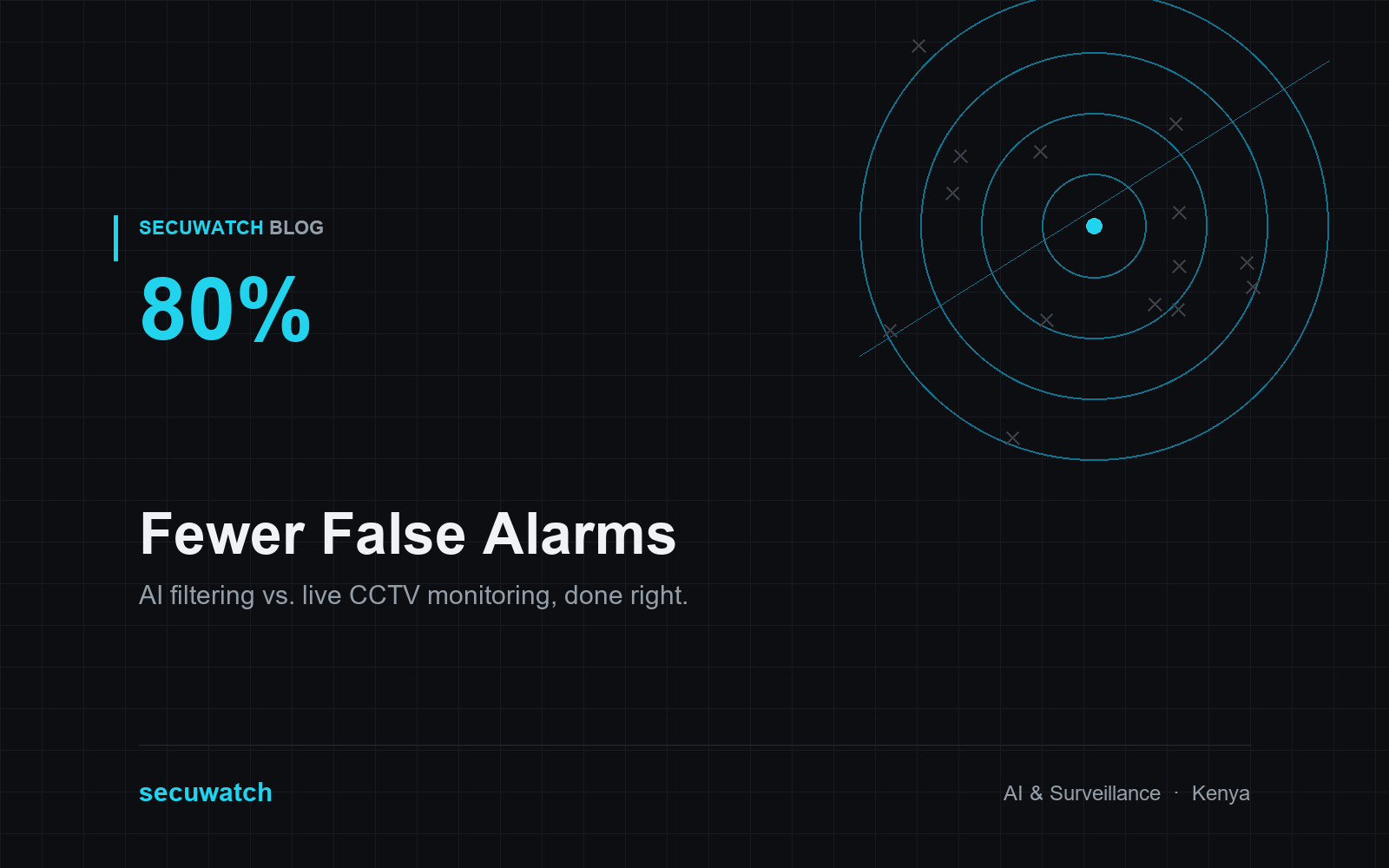
The practical effect is significant. Instead of an operator being pulled toward every trigger a basic sensor produces, the system filters automatically, surfacing only the alerts that genuinely warrant attention. Industry data cited by several security technology providers suggests well-configured AI filtering can reduce false alarm volumes by a substantial margin, with figures as high as 80 percent commonly referenced in vendor and industry literature, though exact results vary considerably depending on site conditions, camera placement, and calibration. Any business considering an upgrade should ask a prospective provider for their own documented performance data rather than relying on general industry figures alone.
Where Live Monitoring Still Matters
It would be a mistake to treat AI video analytics as a replacement for human judgement entirely, and any provider suggesting otherwise is probably overselling the technology. Live CCTV monitoring support, where trained operators watch verified alerts in real time and make the final call on whether to dispatch a guard, alert police, or stand down, remains essential precisely because AI systems, however well trained, still produce occasional false positives and cannot exercise the kind of contextual judgement a human operator brings to an ambiguous situation.
The most effective setups combine both layers deliberately. AI filtering handles the first pass, cutting through the volume of routine, non-threatening motion that would otherwise overwhelm a human monitoring team. Live monitoring then reviews the smaller, more credible pool of AI-flagged alerts and makes the actual decision about how to respond. Machines are good at tireless, consistent pattern filtering across dozens of camera feeds simultaneously, while humans remain better at judging genuinely ambiguous or novel situations that do not fit a pattern the AI was trained to recognize.
Perimeter Intrusion Detection for Industrial and Logistics Sites
For industrial and site managers specifically, perimeter intrusion detection is usually where this technology delivers the clearest value, since large industrial yards and logistics parks are exactly the kind of environment where basic motion sensors generate the most false alerts. A properly configured AI system covering a warehouse perimeter can distinguish routine activity, staff moving between buildings, delivery vehicles arriving on schedule, from genuinely anomalous behaviour, someone approaching the fence line at 3am from an area with no legitimate reason for foot traffic at that hour.
This context-aware detection is particularly relevant given how much of Kenya's reported crime pressure has concentrated in and around Nairobi in recent years. A Kenya National Bureau of Statistics report cited by local media noted that Nairobi recorded a 14.4 percent rise in reported crimes in 2021 compared to the previous year, making it the country's most insecure city by reported case volume at the time. Figures like this help explain why industrial and logistics site managers around Nairobi have become more willing to invest in properly filtered perimeter detection rather than relying on basic motion-triggered systems that struggle to keep pace with both genuine threats and the sheer volume of nuisance triggers a busy, exposed site generates.
A Note on Privacy and Responsible Use
It is worth being upfront that AI-powered CCTV, precisely because it can identify and classify what it sees more precisely than a basic camera, raises real privacy considerations under Kenya's Data Protection Act. Reporting on Kenya's growing CCTV adoption has noted a corresponding rise in privacy-related complaints to the Office of the Data Protection Commissioner, particularly around cameras capturing more than their owner's own property. Businesses deploying AI video analytics should ensure camera placement, data retention, and any behavioural flagging features comply with applicable data protection obligations, and it is sensible to verify specific requirements with a qualified data protection professional rather than assuming a system is compliant simply because it is technically sophisticated.
Choosing the Right Combination for Your Site
Not every facility needs the same balance of AI filtering and live monitoring. A smaller site with a single, well-lit perimeter and low nuisance-trigger volume might do perfectly well with a more modest system and periodic human review. A large, exposed industrial yard bordering open land, dense vegetation, or informal settlements, where wildlife, foot traffic, and weather-related movement are constant, benefits far more from robust AI filtering paired with genuine live monitoring support, since the volume of raw alerts such a site generates would overwhelm a purely human-monitored setup.
This is where working with a provider who actually understands perimeter security for industrial and commercial sites, rather than a general residential CCTV installer, makes a real difference. Secuwatch Tech offers CCTV monitoring support built around this layered approach, combining AI-assisted filtering with live human oversight so that site managers are not left choosing between an unmonitored automated system and a fully manual one that cannot keep pace with a large site's alert volume. For businesses comparing options, Secuwatch Tech also helps connect site and facility managers in Kenya with vetted providers offering perimeter intrusion detection suited to their specific site conditions, rather than a generic package that has not been calibrated for the realities of a particular property.
Conclusion
False alarms are not a minor inconvenience for industrial and logistics site managers in Kenya. They are a genuine security liability, since every ignored or delayed response to alert fatigue represents a moment when a real threat could slip through unnoticed. AI video analytics addresses this by filtering out the weather, wildlife, and shadow-triggered noise that overwhelms basic motion sensors, while live monitoring support ensures the alerts that genuinely matter still get the human judgement they deserve. Providers such as Secuwatch Tech can help facility managers find and compare vetted options that combine both layers properly, which tends to be a far more cost-effective and reliable path to genuine perimeter protection than either technology working alone.