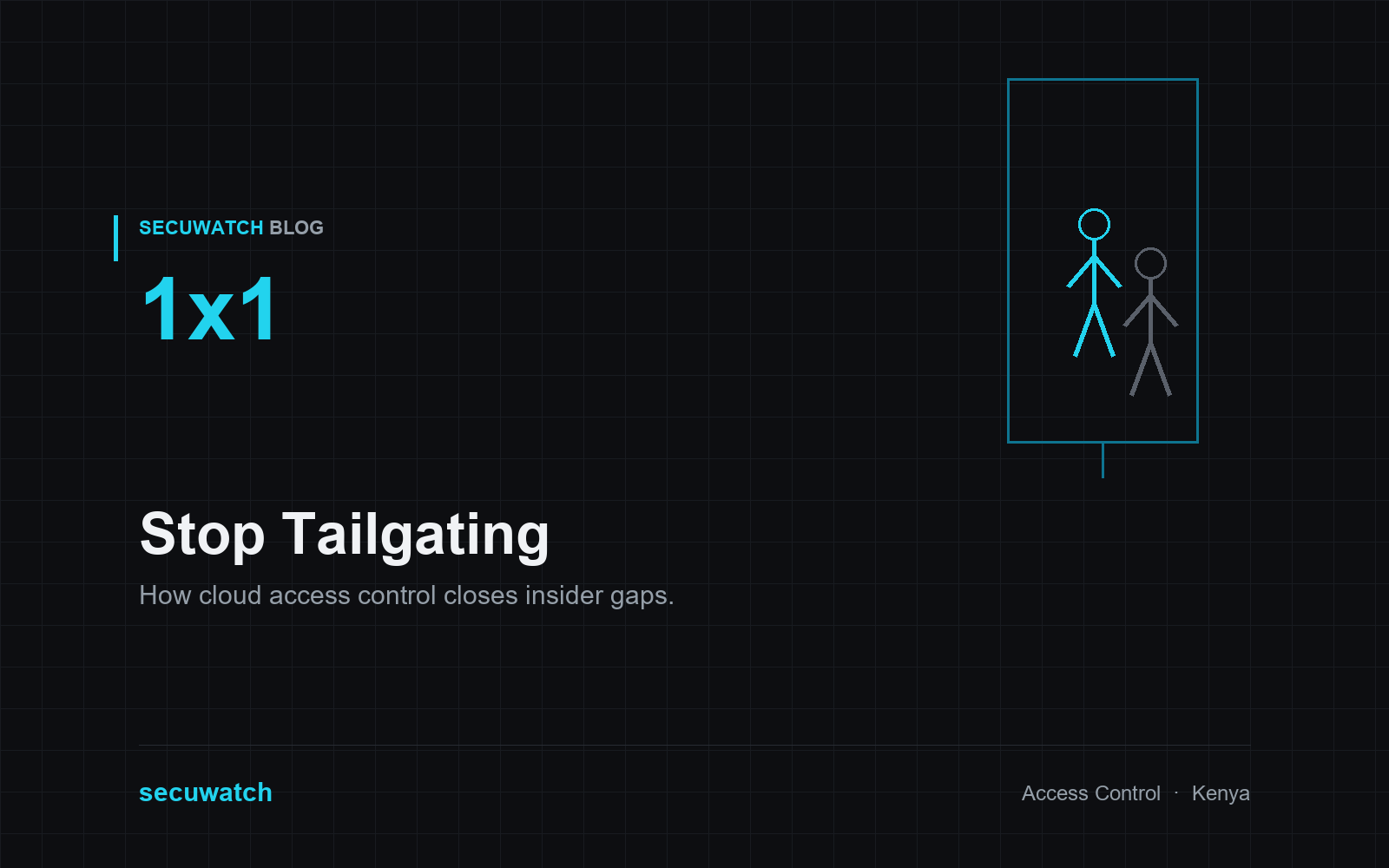
There is a specific moment that plays out in office buildings across Nairobi every single day, and most IT managers never see it happen. An employee badges in at the entrance, holds the door out of politeness for the person walking in right behind them, and neither of them thinks twice about it. That second person might be a colleague who forgot their card. They might also be someone with no business being in the building at all. This is tailgating, and it is one of the most persistent, least discussed security gaps in commercial access control, precisely because it looks like ordinary courtesy rather than a breach.
For IT managers and security directors trying to actually eliminate unauthorized entry rather than just document it after the fact, tailgating sits alongside a related, harder problem: insider threats, where the person misusing access is not a stranger at all, but someone who is supposed to be there and is exploiting that trust. Cloud-based access control has become one of the more effective tools for addressing both, not because it eliminates human behaviour, but because it changes what a system can actually detect, log, and respond to in real time.
Why Tailgating Is Harder to Stop Than It Sounds
Tailgating persists because it works against social instinct. Holding a door for someone is a basic courtesy in most Kenyan workplaces, and asking a stranger to badge in separately can feel awkward, even confrontational, especially in a culture that generally values politeness and avoiding unnecessary friction with people assumed to be colleagues. Security awareness training can reduce this somewhat, but it rarely eliminates it, because the pressure to be polite in the moment usually outweighs an abstract policy reminder.
Traditional keycard systems are largely blind to this problem. A reader confirms that one valid credential was presented, unlocks the door, and has no way of knowing whether one person walked through or five. This is exactly the gap that cloud-based access control, paired with the right supporting technology, is designed to close.
What Cloud-Based Access Control Actually Changes
Cloud-based systems move the intelligence of an access control setup off a single on-site controller and into a centrally managed platform that can process data in real time, apply rules consistently across every door, and flag anomalies as they happen rather than during a periodic review. This shift matters because it turns access control from a passive gatekeeping function into an active monitoring system.
Anti-Passback Protocols Explained
One of the most direct tools against tailgating is anti-passback, a rule that prevents a single credential from being used to enter a space twice in a row without a corresponding exit being logged first. In practice, this means if someone badges in and then hands their card back to a colleague waiting outside to use the same credential, the system flags or blocks the second attempt, since it has no record of that credential having exited.
Anti-passback becomes especially useful in facilities with multiple access points feeding into the same secured zone, such as a data centre, a finance department, or a warehouse with restricted stock areas. It does not stop tailgating on its own, since two people can still walk through a single door together on one valid badge, but it does close a related loophole where credentials are deliberately shared or passed back and forth, a common and often underestimated policy violation in Kenyan offices where staff sometimes share access as a matter of convenience rather than malice.
Real-Time Alert Integration
The real shift with cloud-based systems is how quickly information reaches someone who can act on it. Paired with door sensors and, in more advanced setups, AI-assisted camera analysis capable of detecting multiple people passing through a single authorized entry, a cloud-based platform can send an immediate alert to a security manager's phone or a monitoring dashboard the moment a suspected tailgating event occurs, rather than that event only being discoverable later during a footage review.
This matters considerably for how quickly an organization can respond to a genuine threat. A tailgating event flagged in real time gives security personnel the chance to intervene while the person is still on the premises. The same event discovered two days later during a routine audit offers nothing but after-the-fact awareness, which does very little to prevent whatever happened while that person had unauthorized access.
How This Extends to Insider Threats
Tailgating deals with unauthorized outsiders slipping in behind legitimate credential holders, but insider threats are a distinct and, in many ways, more difficult problem, since the person involved already has legitimate access to at least some part of a facility. Cloud-based access control addresses this less through blocking entry and more through granular permissions and detailed, centralized logging.
Granular, Role-Based Access
A cloud platform makes it straightforward to restrict access by role, time, and location in a way a basic keycard system often cannot manage cleanly. A finance department employee does not need access to a server room. A cleaning contractor does not need access outside their scheduled working hours. When permissions are set this precisely and enforced automatically, the opportunity for an insider to misuse broad, unnecessary access shrinks considerably, simply because that access was never granted in the first place.
Comprehensive Audit Logging for Regulatory Compliance
Every entry, exit, denied attempt, and permission change on a cloud-based system is typically logged automatically, creating a detailed, timestamped audit trail that is far more difficult to dispute or explain away than a paper logbook or a guard's memory. This matters for internal investigations, but it increasingly matters for regulatory reasons too. Kenyan businesses handling sensitive data, financial records, or personal information are subject to obligations under the Data Protection Act, and organizations operating in regulated sectors such as banking, healthcare, or telecommunications often need to demonstrate that access to sensitive areas and systems was properly controlled and recorded. A cloud-based access control system that produces a clean, tamper-resistant audit log makes this kind of compliance reporting considerably less painful than reconstructing access history from fragmented, manually maintained records.
It is worth being realistic here. Audit logs support compliance efforts, but they are not a substitute for understanding the specific regulatory requirements that apply to a given industry, and businesses should verify exact compliance obligations with a qualified data protection or legal professional rather than assuming a security system alone satisfies every requirement.
Common Questions IT Managers and Security Directors Ask
A frequent question is whether cloud-based access control requires constant, uninterrupted internet connectivity to function, which is a genuine concern in parts of Kenya where connectivity can be inconsistent. Most well-designed cloud-based systems include local fallback capability, meaning doors continue to function using locally cached credentials during a brief outage, with data syncing back to the cloud platform once connectivity is restored. It is worth confirming exactly how a specific provider's system behaves during an outage before committing, since this varies meaningfully between vendors.
Another common question involves cost, and while cloud-based systems generally involve a subscription element in addition to hardware, many organizations find the operational savings, faster offboarding, centralized management across multiple sites, reduced administrative overhead, offset a meaningful portion of that ongoing cost over time. Exact pricing varies considerably depending on the scale of a facility and the specific features required, and it is sensible to get a detailed, itemized quote from more than one provider rather than relying on a general estimate.
Building a Layered Defense Rather Than Relying on One Feature
Cloud-based access control works best as part of a layered approach rather than a single fix. Anti-passback protocols close one specific loophole. Real-time alerts shorten the gap between an incident occurring and someone actually knowing about it. Granular permissions limit what any single compromised or misused credential can actually reach. Audit logging supports both internal accountability and external compliance. None of these individually eliminates tailgating or insider risk entirely, but together they meaningfully reduce both the likelihood of an incident going unnoticed and the potential damage if one does occur.
For organizations in Kenya evaluating this kind of system, working with a provider who genuinely understands commercial access control, rather than a general security installer applying a residential mindset to a business environment, makes a real difference in how well these features are configured and maintained. Platforms such as Secuwatch Tech can help business owners and security managers in Kenya find and compare vetted providers offering cloud-based access control with anti-passback protocols, real-time alerting, and proper audit logging, rather than committing to whichever installer offers the lowest quote without verifying their actual experience with these more advanced features.
Conclusion
Tailgating and insider threats persist because they exploit trust and habit rather than obvious technical weaknesses, which is exactly why they are so easy to overlook until something goes wrong. Cloud-based access control does not remove the human element from security, and it should not be sold as a complete solution on its own. What it does offer is a meaningfully faster, more granular, and more accountable way of detecting and responding to exactly the kind of quiet, everyday breaches that traditional keycard systems were never built to catch. For IT managers and security directors serious about closing these gaps, that shift in visibility and response time is often the difference between catching a problem early and finding out about it only after real damage has been done.