A retail shop owner in Westgate or a supermarket manager in Nakuru town is often quoted two very different numbers for the same open-plan space. One installer proposes a single fisheye 360 CCTV camera Kenya suppliers stock, mounted centrally on the ceiling, covering the entire floor. Another proposes six standard cameras positioned around the same room. The price difference on the quote sheet looks obvious at first glance, but the real cost comparison is more complicated than counting camera units, and getting it wrong either overspends on hardware the space did not need or leaves genuine blind spots that only become obvious after a theft has already happened.
This decision comes up constantly for retail stores, open-plan offices, and parking lots across Kenya, spaces where a single wide field of view feels tempting precisely because it promises to simplify what would otherwise be a more complex multi-camera installation.
What a Fisheye or 360-Degree Camera Actually Does
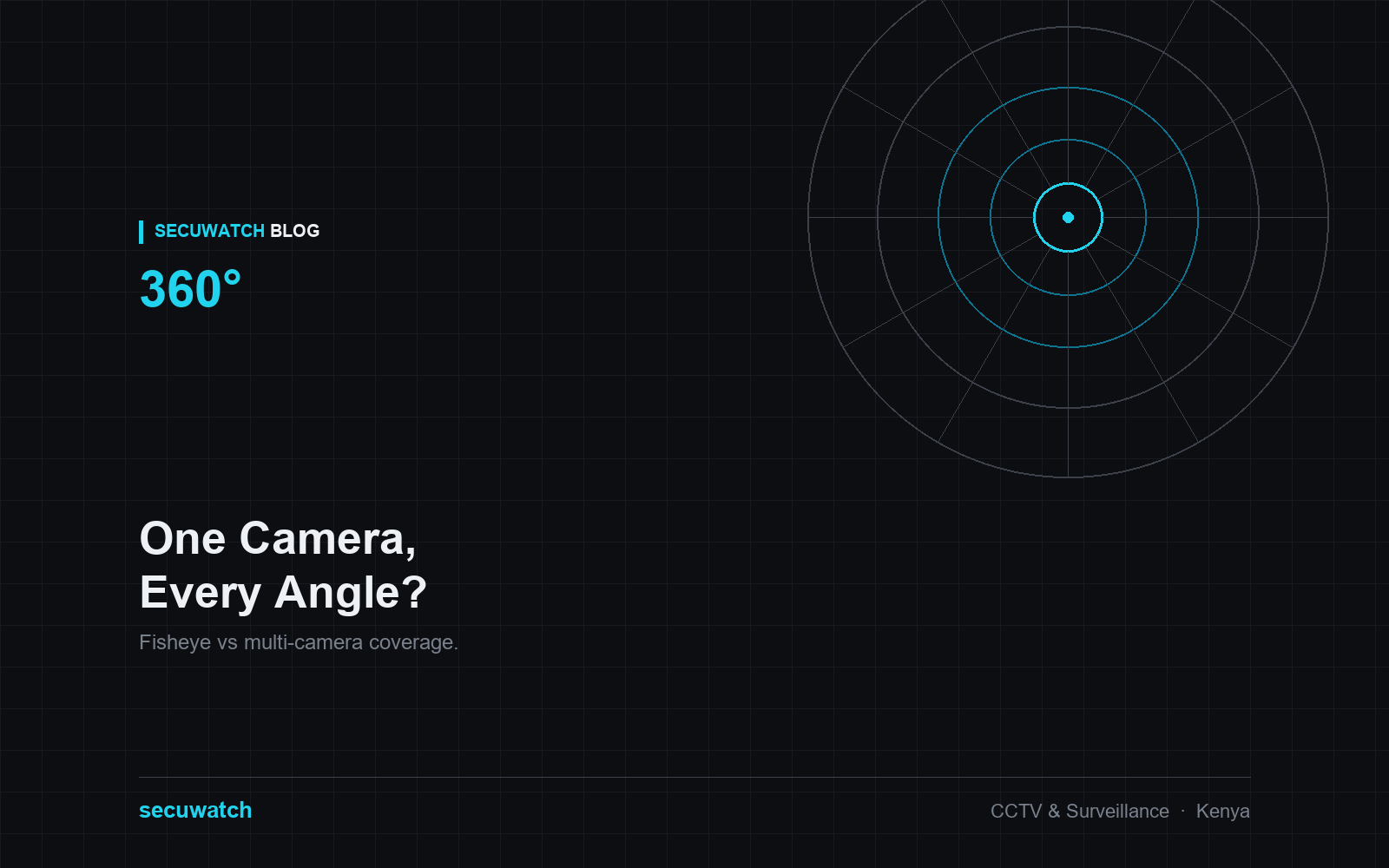
A fisheye camera uses an extremely wide-angle lens, often capturing a full 180 or 360-degree field of view from a single fixed position, typically mounted on the ceiling looking straight down. The distinctive curved, panoramic image this produces is later "dewarped" by the camera's software, meaning the raw circular footage is digitally corrected into a flat, viewable image, or split into several virtual views that can be examined independently, even though it all comes from one physical camera and one lens.
This is different from a standard fixed camera, which covers only the specific angle it is physically pointed at, and different again from a pan-tilt-zoom camera, commonly shortened to PTZ, which can be manually or automatically moved to follow activity but only covers one direction at any given moment. A fisheye camera's advantage is that it records everything within its wide field of view simultaneously, all the time, without needing to be aimed.
Where a Single Fisheye Camera Genuinely Saves Money
For a reasonably compact, open space with few physical obstructions, a supermarket aisle floor, a small open-plan office, or a modest parking area, a single well-placed fisheye camera can genuinely replace what would otherwise require three or four standard cameras. This translates into fewer cables to run, fewer mounting points to install, and often a lower total cost on both hardware and labour, which matters considerably for a business watching its installation budget closely.
Wide angle security cameras of this type also simplify future monitoring, since a single video feed covering an entire room is often easier for a shop attendant or receptionist to glance at than switching between multiple camera views on a split screen. For businesses without a dedicated security operations setup, this practical simplicity is a real, underappreciated benefit.
Where Multi-Camera Setups Still Make More Sense
The limitations of a single fisheye camera become clear once a space has physical obstructions, shelving units in a supermarket, partition walls in an office, or parked vehicles in a larger lot, since anything blocking the camera's direct line of sight creates a genuine blind spot that a wide lens cannot see around. A single centrally mounted fisheye camera assumes an open sightline, and retail spaces with tall shelving, a very common layout across Kenyan supermarkets, often defeat this assumption entirely.
Image detail is another real trade-off worth being honest about. Because a fisheye camera spreads its resolution across a much wider area, the level of detail on any specific point, a person's face near the edge of the frame, for instance, tends to be lower than what a standard camera pointed directly at that same spot would capture. For businesses that specifically need clear facial identification at entry points or till areas, a dedicated standard camera aimed precisely at that zone often outperforms a fisheye camera covering the same general area from a distance.
Larger or irregularly shaped spaces, such as a sprawling parking lot with multiple entry and exit points, generally cannot be covered by a single fisheye unit at all, and pretending otherwise to save on installation cost usually backfires, since the resulting coverage gaps are exactly where incidents tend to happen.
Common Mistakes Businesses Make With This Decision
The most frequent mistake is choosing based purely on unit price rather than actual coverage needs. A single fisheye camera costing less than four standard cameras looks like an obvious saving on paper, but if the space has enough obstructions to create meaningful blind spots, the business ends up paying for a system that does not actually protect what it was meant to protect, which is a worse outcome than a slightly higher-cost multi-camera setup that does the job properly.
Another common issue is assuming a fisheye camera's dewarping software works equally well across all price points. Cheaper fisheye cameras, often the lower end of what appears on Kenyan e-commerce listings, sometimes produce noticeably distorted or lower-quality dewarped footage compared to established brands, which matters considerably if footage ever needs to be reviewed carefully after an incident. It is worth asking any installer to demonstrate the actual dewarped image quality before committing, rather than relying on marketing photos.
Comparing Installation Costs and Providers
Commercial camera installation cost Nairobi businesses are quoted varies considerably depending on the number of camera units, cable runs required, storage capacity, and whether the installer is offering basic fixed cameras, fisheye units, or a mix of both. Rather than comparing a single headline figure, it is worth asking any installer for an itemised breakdown covering hardware, cabling, labour, and any recorder or storage costs separately, since bundled lump-sum quotes make genuine comparison between providers difficult.
- Licensing: confirm the installer is licensed under the Private Security Regulatory Authority (PSRA), a requirement that covers security technology providers as well as traditional guarding firms.
- Certifications: larger integrators serving corporate or multi-branch clients sometimes hold ISO 18788, though this matters more for larger retail chains than a single shop.
- Service scope: whether ongoing maintenance, firmware updates, and technical support are included or billed separately.
- Technology currency: dewarping quality and low-light performance have improved considerably across recent camera generations, and an installer pushing older stock may not disclose this unless asked directly.
- Fault response times: particularly important for a retail environment where even a short period of blind coverage during business hours carries real risk.
- Transparent pricing: a reputable provider should be comfortable walking you through exactly what each cost component covers.
For business owners unfamiliar with which local installers actually have solid experience with fisheye and wide-angle systems specifically, platforms like Secuwatch Tech can help narrow down vetted security technology providers across different Kenyan counties, which is particularly useful when comparing a fisheye proposal against a multi-camera one and wanting a second, independent opinion on which actually suits your specific floor plan.
Making the Right Call for Your Space
There is no universally cheaper option between a single 360-degree camera and a multi-camera setup. The right answer depends entirely on your space's actual layout, obstructions, and what level of detail you genuinely need at specific points like tills, entrances, or high-value shelving. A small, open, obstruction-free room is often well served by a single good-quality fisheye unit at a real cost saving. A retail floor packed with shelving, or a sprawling parking lot with multiple access points, usually needs a properly planned multi-camera layout to avoid blind spots that end up costing far more than the installation savings were ever worth.
Before deciding, ask any installer to walk your actual space with you, point out where a fisheye camera's coverage would and would not reach, and provide separate quotes for both approaches so you can compare them honestly rather than choosing based on the smaller number on the page.