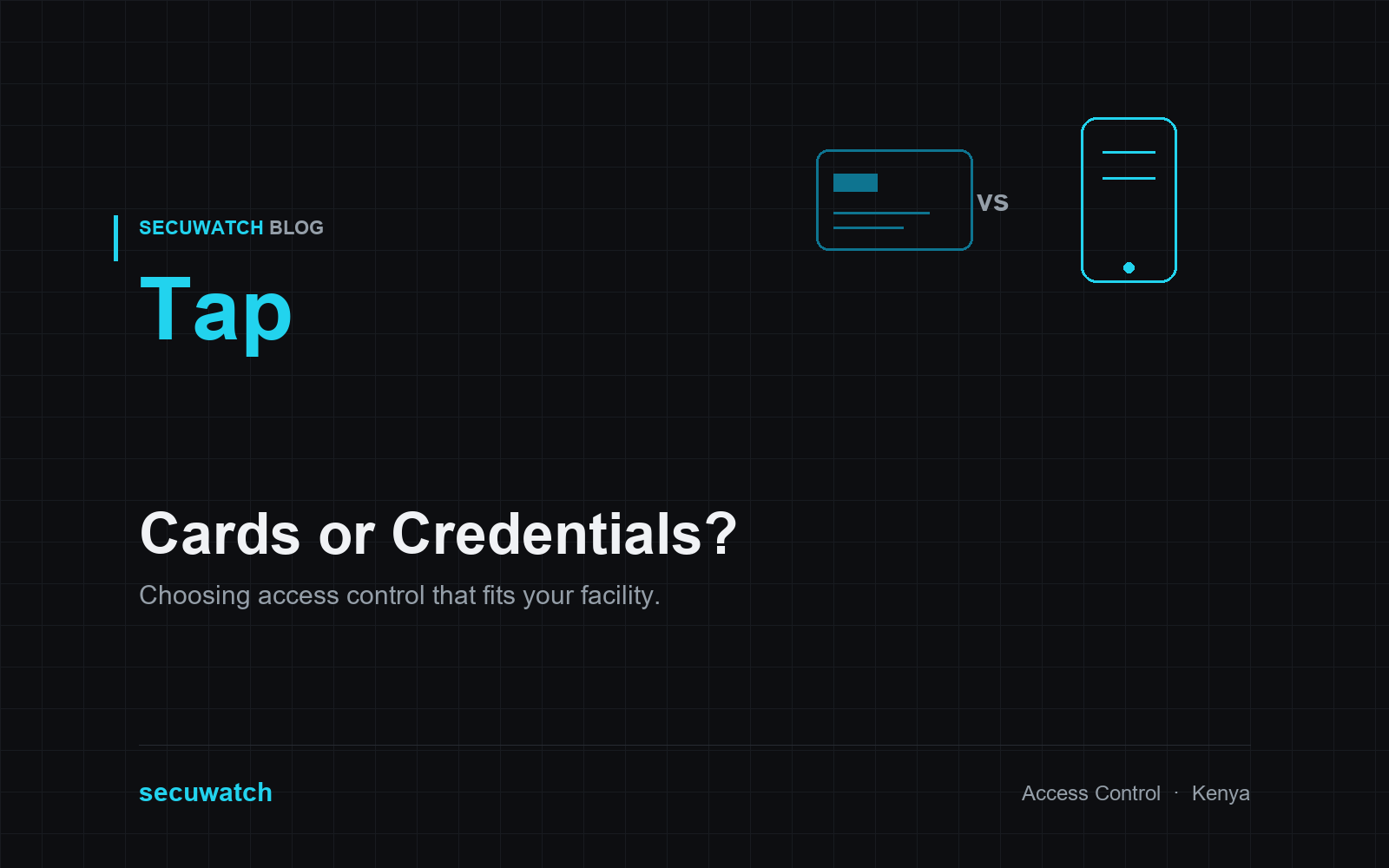
Walk into almost any office building along Waiyaki Way or a business park in Upper Hill today, and you will notice the same small ritual playing out at the entrance. Someone taps a plastic card against a reader, waits for the beep, and pushes through. It works, mostly, until the day that card goes missing from someone's bag on a matatu, or a former employee still has one sitting in a drawer six months after leaving the company. That small, everyday friction is exactly what is pushing more Kenyan businesses to ask a question that did not really come up a decade ago: should we be using keycards at all, or is it time to move to mobile-based access control?
This is not a purely technical decision, and it should not be treated as one. Choosing between keycards and mobile credentials affects daily operations, staff convenience, security accountability, and cost, sometimes in ways that only become obvious after a system has already been installed. Understanding how the two approaches actually differ, in practice rather than in a sales brochure, makes it much easier to pick the one that genuinely fits a given facility.
What Keycard Access Control Actually Involves
Keycard systems have been the default for commercial access control in Kenya for a long time, and there is a reason they have stuck around. A keycard, whether it uses simple RFID technology or a more advanced smart chip, is issued to an employee, tenant, or contractor, and a reader mounted at each door checks it against a database before unlocking. It is a mature, well understood technology, and most security installers in Kenya are comfortable setting it up and maintaining it.
The appeal is straightforward. Keycards do not depend on an employee's phone having battery life or a working app, they work reliably even in buildings with patchy internet connectivity, and issuing a new card is a fairly quick, low-friction process that does not require staff to install anything. For facilities with stable, relatively low staff turnover, and where budget constraints matter more than cutting-edge features, keycards remain a genuinely sensible choice, not an outdated one.
The drawbacks tend to show up gradually rather than immediately. Physical cards get lost, and each lost card either needs replacing at a cost or, more importantly, needs to be deactivated promptly to avoid leaving an active credential floating around unaccounted for. Cards can also be shared informally between colleagues, which quietly undermines the entire point of individual access tracking, since a system that cannot reliably confirm who actually used a credential is not offering much real accountability. And in facilities with several access points, managing a growing pool of physical cards, especially for contractors, cleaners, and other rotating personnel, becomes an administrative task that someone has to stay on top of consistently, which does not always happen in practice.
What Mobile Credential Access Control Actually Involves
Mobile credentials replace the physical card with a digital one, typically an app on an employee's smartphone or, in some systems, a Bluetooth or NFC signal that a phone transmits to a reader without the user needing to open anything. Access can be granted, adjusted, or revoked remotely and instantly, without needing anyone to physically hand over or collect a card.
This creates some genuinely useful advantages for the right kind of facility. Offboarding a departing employee becomes a matter of tapping a button rather than tracking down a physical card that may or may not get returned. Temporary access for a contractor, a delivery driver, or a visitor can be issued for a specific time window and expire automatically, which is difficult to replicate cleanly with a physical card system. Detailed access logs are often built in by default, giving facility managers a much clearer picture of who entered where and when, which matters considerably if an incident ever needs to be investigated.
The trade-offs are real too, and worth being honest about. Mobile credential systems depend on staff actually having a functioning smartphone with sufficient battery, and on a reasonably stable internet or Bluetooth connection at the point of entry, which is not guaranteed in every part of Kenya, particularly for facilities in areas with less reliable connectivity. Staff who are less comfortable with smartphone apps, a real consideration for some cleaning, security, or maintenance personnel, may need more support during the transition than a simple card ever required. And the upfront cost of a mobile credential system is often higher than a comparable keycard setup, particularly if a facility is retrofitting rather than building access control in from the start.
Comparing the Two on the Factors That Actually Matter
Cost and Budget Realities
Keycard systems generally have a lower upfront cost, and the ongoing expense of replacing occasional lost cards is usually modest. Mobile credential systems tend to cost more initially, both for the software licensing and for readers capable of handling Bluetooth or NFC communication, though many providers price this as a subscription that includes support and updates. For a small business in Kenya working with a tight budget, this difference is often the deciding factor, and it is worth getting a clear, itemized quote from more than one provider before committing either way.
Security and Accountability
Mobile credentials generally offer stronger accountability, since a smartphone tied to an individual is harder to casually hand off than a plastic card, and the ability to revoke access instantly closes a gap that keycard systems struggle with, particularly around employee departures. That said, a mobile system is only as secure as the phone it lives on, and a facility with weak device security policies among staff can undermine some of that advantage.
Convenience and Staff Experience
Keycards are simple and require no learning curve, which matters in facilities with a large, varied workforce, including staff who may not be comfortable relying on a smartphone app for something as routine as entering their workplace. Mobile credentials offer more convenience for tech-comfortable staff, since many systems allow hands-free entry, but they introduce a dependency on a device that not everyone treats with the same reliability as a physical card kept in a wallet.
Scalability for Growing Facilities
Businesses expanding into multiple locations, or managing frequent staff and contractor turnover, tend to find mobile credential systems considerably easier to scale, since adding or removing access does not require physically distributing or collecting hardware. For a facility that is not expecting to grow or change staffing patterns significantly, this advantage matters less.
Questions Worth Asking Before Choosing Either System
A few honest questions tend to clarify which direction makes sense for a specific facility. How reliable is the internet and power supply at the actual site, not just in general but at that specific location? How often does staff turnover happen, and how painful has offboarding been under the current system? Does the workforce include a significant number of people who may struggle with a smartphone-based system, whether due to device access or comfort with the technology? And realistically, what is the budget for both the initial installation and the ongoing running costs, since the cheaper option upfront is not always the cheaper option over several years.
Choosing a Provider Who Can Actually Support Either Option
Not every security installer in Kenya is equally experienced with mobile credential systems, since keycard installation has been the more common, established service for years. Business owners considering the switch should ask providers directly about their track record with mobile-based systems specifically, including how they handle connectivity issues, staff onboarding, and what support looks like if something goes wrong after installation. It is also reasonable to ask whether a hybrid approach, keycards for staff who need the simplicity and mobile credentials for others, is something a provider can actually configure, since many commercial facilities in Kenya end up finding real value in exactly that kind of blended setup rather than switching entirely to one system.
Comparing more than one provider before committing is worth the extra time it takes, particularly given how much the quality of installation and ongoing support varies. Platforms such as Secuwatch Tech can help business owners in Kenya find and compare vetted access control providers offering both keycard and mobile credential systems, which makes it easier to get a realistic, side-by-side sense of pricing and capability rather than relying on a single installer's pitch.
Conclusion
There is no universally correct answer to the keycard versus mobile credential question, despite how confidently some providers might present one option as clearly superior. Keycards remain a solid, dependable choice for facilities with stable staffing, tighter budgets, or less reliable connectivity. Mobile credentials offer real advantages in accountability, flexibility, and ease of managing a changing workforce, but they come with higher upfront costs and a dependency on technology that not every facility can rely on evenly across its staff. The right choice comes down to an honest assessment of a business's specific staffing patterns, budget, and physical environment, rather than assuming the newer technology is automatically the better fit.