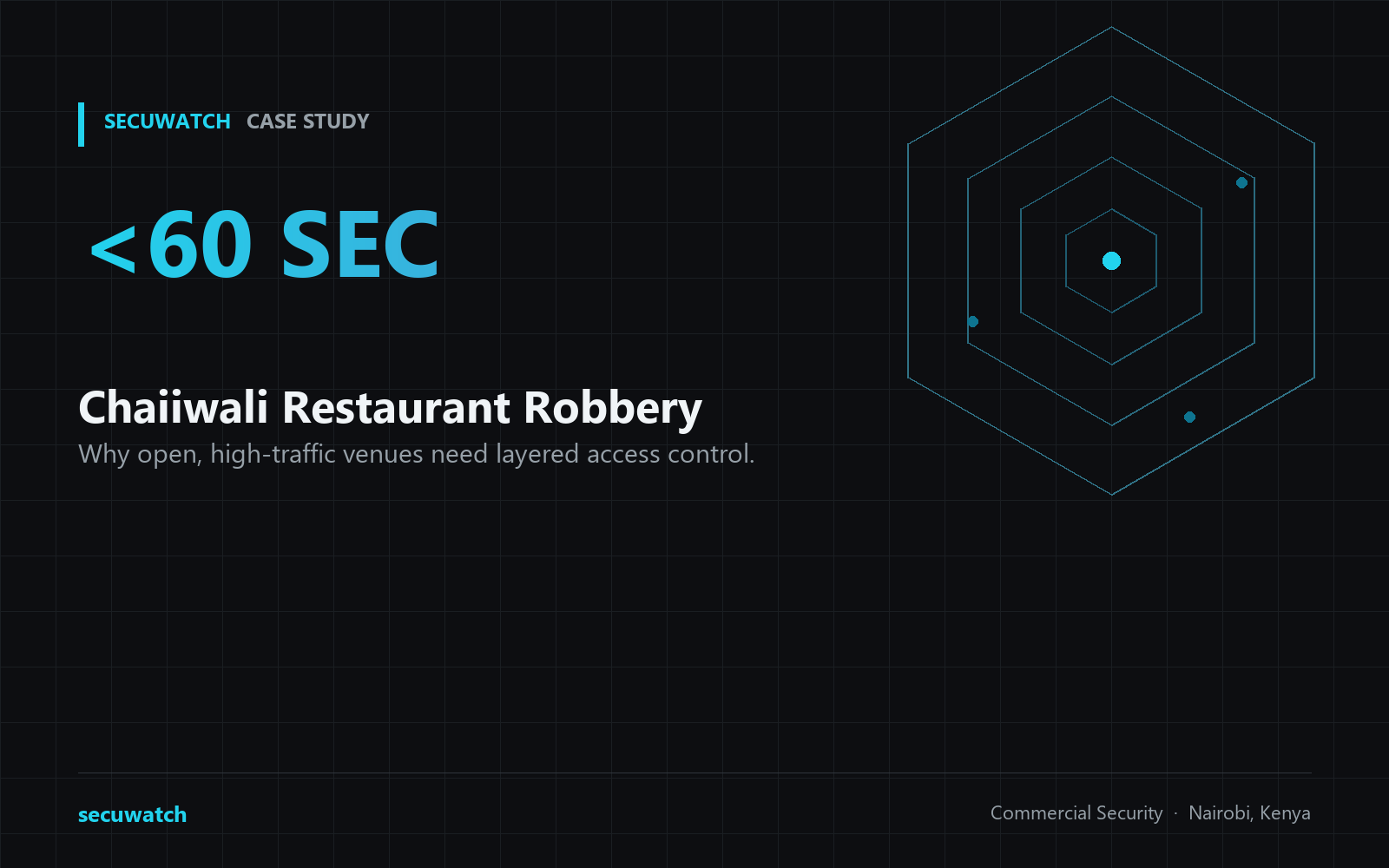
On the night of 4 July 2026, diners at Chaiiwali restaurant along General Mathenge Road in Nairobi's Spring Valley were having what was probably an ordinary evening out, the kind of relaxed weeknight dinner that happens at popular eateries across Westlands every day. Then two armed men walked in posing as customers, drew pistols, and within less than a minute had robbed patrons of seven mobile phones and a laptop before firing shots into the air and fleeing on motorcycles toward Parklands. The entire incident was captured on CCTV, and it has since become one of the more widely discussed security cases in Nairobi's restaurant and hospitality scene — not because it was unusually violent, but because it exposed how vulnerable even a busy, well-lit, popular commercial space can be.
For business owners running restaurants, cafés, retail outlets, and other high-traffic commercial premises in Kenya, the Chaiiwali case is worth studying carefully, not as sensational news, but as a genuine lesson in where security gaps tend to hide in spaces that are open to the public.
What Actually Happened at Chaiiwali
According to police accounts, the two gunmen entered the restaurant the same way any customer would, through the main entrance, during normal operating hours. There was no forced entry, no broken lock, and no bypassed gate. They simply walked in, blended in for a moment, then moved from table to table demanding valuables before escaping. A security guard on site attempted to intervene and was met with a warning shot fired at the ground. Investigations that followed linked the attack to a wider criminal network responsible for a string of robberies across Nairobi, Kiambu, and Machakos counties, and in the weeks after the incident, police made several arrests connected to the case, recovering firearms believed to have been used in the attack.
It is worth being precise about what this case does and does not represent. This was not a break-in that exploited a weak padlock or an unmonitored back door. It was an armed robbery carried out in plain sight, during business hours, against a venue that was open to the public by design. That distinction matters, because it shapes what kind of security response is actually relevant here, and it would be misleading to suggest that any single measure, including access control, would have stopped armed men from walking through a front door that is meant to be open to customers.
Where the Real Vulnerabilities Sit in High-Traffic Venues
That said, the Chaiiwali case still points to real, addressable gaps that apply broadly across Nairobi's commercial outlets, particularly restaurants, retail shops, and hospitality venues in high-density zones like Westlands, Kilimani, and the CBD. Public-facing entrances are, by necessity, hard to lock down without ruining the customer experience — nobody wants a restaurant that feels like a fortress. But the areas around and behind that public entrance are usually where meaningful security improvements are still possible.
Shared keys and uncontrolled staff access
Staff entrances, delivery doors, and back-of-house areas in many restaurants and shops still rely on shared physical keys or basic keycards that have been in circulation for years, sometimes handed to former employees who never returned them. High staff turnover, which is common in Kenya's hospitality sector, makes this a persistent and often ignored risk. A former waiter or kitchen hand who still holds a spare key is a liability that most restaurant owners never think to address until something goes wrong.
Underdeveloped response protocols
Response protocols during an active incident are another area that tends to be underdeveloped. In the Chaiiwali case, a guard tried to physically intervene, which is a natural human reaction but not necessarily the safest one when firearms are involved. Businesses that operate in higher-risk zones benefit from having a clear, rehearsed protocol for what staff and security personnel should do during an armed incident, prioritising safety over confrontation, along with a reliable way to alert police and any monitoring service immediately.
The Case for Cloud-Based Access Control in Commercial Spaces
While access control would not have stopped the specific walk-in robbery at Chaiiwali, it remains one of the more practical upgrades available to restaurants, retail outlets, and other commercial premises looking to close the gaps that traditional lock-and-key systems leave open elsewhere on the property. Cloud-based access control systems, which use mobile credentials or app-based entry instead of physical keys or static keycards, solve a specific and very common problem: the accumulation of lost, duplicated, or unreturned keys over years of staff turnover.
With a mobile credential system, a manager can revoke a former employee's access instantly from a phone, without needing to change a physical lock or reissue keycards to everyone else. Real-time door monitoring adds another layer, alerting management if a staff or delivery entrance is opened outside expected hours — which is often exactly when opportunistic break-ins happen at restaurants that are locked up for the night after a long service. For high-traffic hubs with multiple entry points, kitchens, storage rooms, delivery bays, and staff areas, this kind of system creates accountability that a shared padlock key circulating among a dozen employees simply cannot match.
This is where working with a properly vetted security technology partner matters, since not every company offering access control in Kenya installs or configures these systems well, and a poorly set up mobile credential system can end up being more confusing than the manual one it replaced. At Secuwatch, we help business owners in Kenya compare and find vetted providers for access control, CCTV monitoring, and guarding services, which is useful when trying to avoid installers who oversell a system without properly training staff on how to use it.
Balancing Openness With Genuine Protection
Restaurants and retail spaces face a security challenge that offices and warehouses do not, since their entire business model depends on being welcoming and accessible to strangers. This makes the Chaiiwali case a useful reminder that commercial security in Kenya cannot rely on a single layer, whether that is a guard at the door, a camera above the till, or a lock on the staff entrance. It needs to combine visible deterrents, monitored entry points where locking down is actually practical, trained staff response protocols, and a genuine relationship with local police and private security providers who can respond quickly when something does go wrong.
Business owners evaluating their own premises after reading about a case like this should start by mapping every entry point into the building, not just the main door, and asking honestly which of those points are properly monitored, which still rely on shared or outdated keys, and which have no monitoring at all. That audit alone tends to reveal more than most owners expect.
A Realistic Takeaway for Kenyan Business Owners
The Chaiiwali robbery was ultimately a story about armed criminals exploiting the openness that any public-facing business has to offer, and no commercial venue can fully eliminate that risk while still welcoming customers through the front door. What businesses can control is everything else around that risk: tightening access to staff areas, closing the gap left by years of uncontrolled key distribution, improving monitoring at secondary entrances, and making sure staff have a clear, safety-first response plan rather than improvising during a crisis. Those are the layers of protection that are genuinely within a business owner's control, and getting them right is a far more productive use of time and budget than assuming a single measure will cover every possible scenario.