Eastleigh has one of the busiest, most concentrated retail scenes in Nairobi, with multi-storey malls like Garissa Lodge, Bristol Park, and Prime Mall packed floor to floor with shops selling everything from electronics to clothing to household goods. That density is exactly what makes the area so commercially successful, and it is also part of what makes it a persistent target for organised theft. Where there is a lot of high-value stock moving through a relatively compact space, there tends to be someone studying the patterns, testing the gaps, and coming back more than once if the first attempt goes unnoticed.
This pattern, of criminals returning repeatedly to businesses with weak or poorly monitored surveillance, is worth understanding properly, because it explains why retail CCTV installation in Kenya has become less about simply having a camera and more about having a system that can actually see, flag, and respond to a threat in real time.
A Recent Eastleigh Case That Shows the Pattern in Action
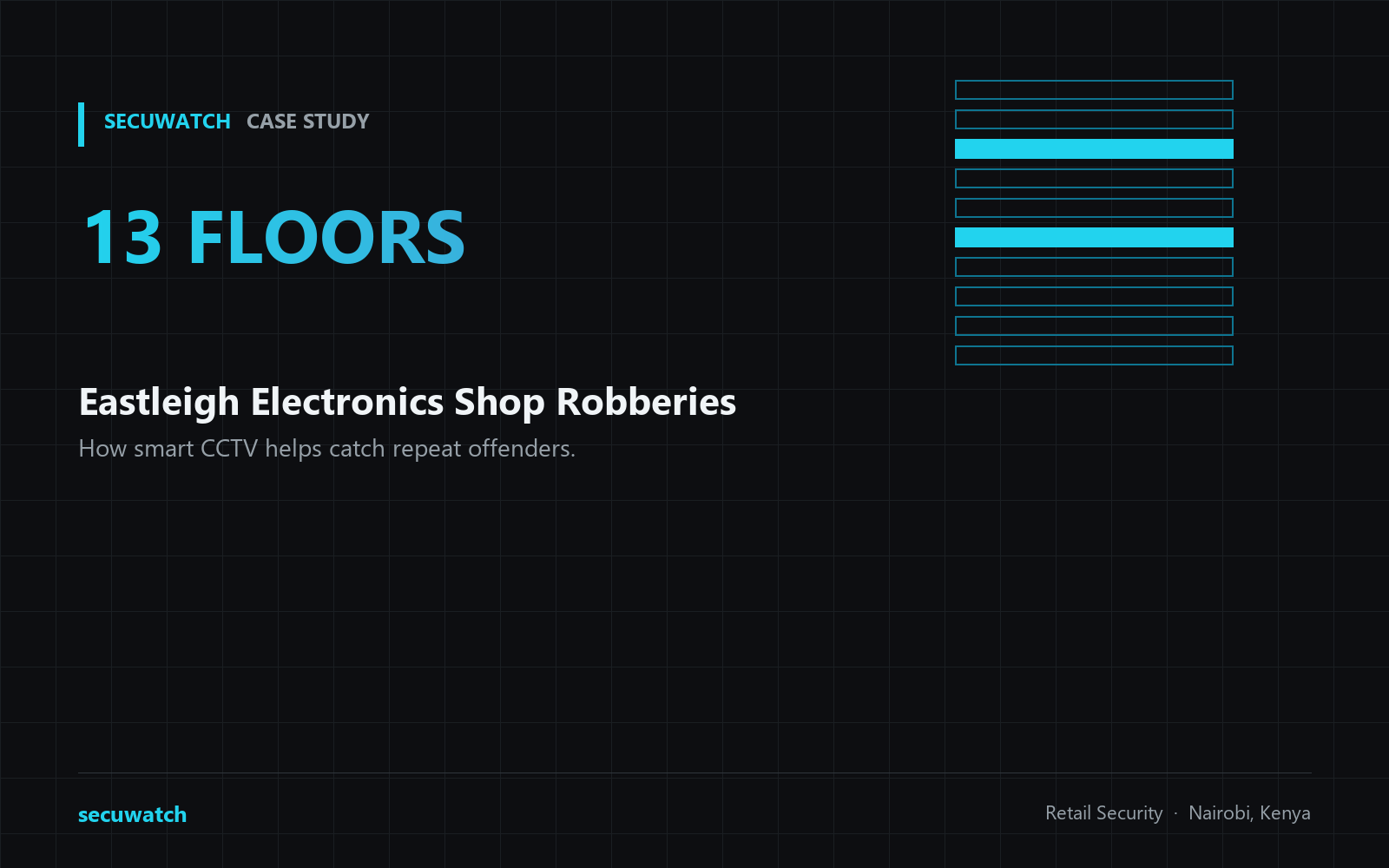
In February 2026, security officers at Prime Mall in Eastleigh caught two suspects attempting to break into a shop using what police believe was a master key. According to reporting on the incident, the men were seen on CCTV moving through several floors of the mall in a way that raised suspicion, starting on the fifth floor before working their way up to the thirteenth, then back down to the eighth floor, where they identified a padlocked store that appeared poorly secured. Security officers stationed in the mall's control room were watching the footage in real time as the suspects surveyed the corridor and attempted to force the lock, and were able to intervene and detain the pair inside the building before police even needed to be called.
What makes this case genuinely useful as a case study is not just that the attempted break-in failed, but how it failed. This was not a passive camera system that happened to capture footage someone reviewed after the fact. It was an actively monitored setup where trained personnel were watching live feeds and were able to respond while the intrusion was still unfolding, catching what appeared to be a deliberate, floor-by-floor reconnaissance pattern rather than a single opportunistic attempt.
Why High-Value Inventory Keeps Attracting Organised Crime
Electronics shops sit near the top of the list for organised retail theft in Kenya, and the reasons are fairly straightforward. Phones, laptops, and accessories are compact, easy to move, and hold value that converts quickly into cash through informal resale networks. A single successful break-in at the right shop can yield goods worth far more than a comparable theft from almost any other type of retail business, which is part of why break-ins targeting electronics dealers tend to be more planned and coordinated than opportunistic shoplifting.
This dynamic is not unique to Eastleigh. In April 2026, a well-known computer retailer operating as Mr Bingo Computers at Twiga Towers in Nairobi's central business district lost more than 500 computers and over 100 iPhones in a single overnight break-in, valued at around Sh16 million. CCTV footage from the incident reportedly showed the gang engaging security guards in casual conversation hours before the break-in, suggesting a degree of reconnaissance and planning that goes well beyond a spur-of-the-moment theft. Cases like this, alongside the pattern of repeated shoplifting and distraction theft that has been documented at various Eastleigh boutiques and electronics stalls, point to the same underlying reality: businesses holding genuinely high-value, easily resold inventory are being actively studied by people looking for the weakest point of entry.
What Smart CCTV Actually Adds Beyond a Standard Camera
A basic CCTV setup records footage, which is useful after the fact but does very little to stop anything from happening in real time. The Prime Mall case worked precisely because the system in place was being actively monitored, which is the first and most important upgrade any electronics retailer or mall management team can make. AI-powered CCTV takes this a step further by using motion detection and behavioural analysis to flag unusual activity automatically, rather than relying entirely on a human watching multiple screens continuously, which is difficult to sustain for hours at a time without gaps in attention.
Motion alerts sent directly to a shop owner's or security manager's phone mean that unusual activity after hours, in a stockroom, or near a specific high-value display, triggers an immediate notification rather than sitting unnoticed until someone happens to review footage the next day. This closes exactly the kind of gap that allowed the Mr Bingo Computers break-in to unfold undisturbed overnight, since a monitored alert system covering the relevant hours could have flagged the intrusion the moment it began rather than leaving it to be discovered the following morning.
Facial Recognition and Camera Positioning: What to Know Before Investing
Camera positioning that supports facial recognition — meaning cameras angled and placed specifically to capture clear, front-facing images at entrances and key transaction points — can genuinely help identify repeat offenders who return to the same mall or shopping area after a previous attempt. This is particularly relevant in a dense retail environment like Eastleigh, where the same individuals casing multiple shops across different visits, as appeared to happen in the Prime Mall case, are more likely to be recognised and flagged if the system is designed with that specific goal in mind rather than simply pointed at the till.
It is worth being upfront about the legal side of this. Kenya's Data Protection Act treats CCTV operators, including those using facial recognition-capable systems, as data controllers with real obligations, including registration with the Office of the Data Protection Commissioner and, depending on how the footage is used, appropriate notice to the people being recorded. A Kenyan High Court ruling in a separate dispute over residential CCTV placement confirmed that camera operators can be held accountable under the Act for how and where footage is collected. Business owners considering facial recognition-capable systems should factor in this compliance requirement from the start rather than treating it as an afterthought, since a system installed without proper regard for data protection obligations can create legal exposure of its own.
Remote Viewing and Why It Matters for Shop Owners Who Cannot Be On-Site
Many electronics retailers in Eastleigh, Garissa Lodge, and similar shopping complexes are run by owners who manage multiple stalls or divide their time between different locations, which makes constant on-site presence impractical. Remote viewing, meaning the ability to check live or recorded footage from a phone or computer regardless of physical location, gives owners a way to stay genuinely aware of what is happening on their premises without needing to be there in person. This becomes particularly valuable during off-peak hours or when a shop is closed overnight, which is precisely when a large share of the more serious break-ins tend to occur.
Securing Stock Rooms With Proper Access Control
CCTV alone, however advanced, still functions mainly as detection rather than prevention. Access-controlled stock rooms add a second layer that becomes especially important for electronics retailers, since the actual high-value inventory is often stored behind the sales floor rather than displayed openly. Limiting stockroom access to specific, verified staff, and logging exactly who enters and when, closes off an avenue that a purely camera-based system cannot address on its own, particularly in businesses where staff turnover is frequent and informal key-sharing has become the norm.
Choosing a Provider That Understands Retail Security in Kenya
Not every CCTV installer offers genuinely monitored systems, motion-triggered alerts, or properly configured access control, and electronics retailers evaluating providers should ask specific questions about these capabilities rather than assuming a standard package covers them. It is also worth asking how a provider handles data protection compliance if facial recognition features are involved, since this is a real legal consideration rather than a technical afterthought.
Comparing providers with genuine experience securing high-footfall retail environments, rather than committing to whichever installer happens to be most convenient, is a worthwhile investment of time. At Secuwatch, we help business owners in Kenya find and compare vetted security providers offering AI-powered CCTV, motion alerts, access control, and cloud recording suited specifically to retail environments like those found across Eastleigh's malls and shopping streets.
A Grounded Conclusion
The Prime Mall case is a useful reminder that CCTV works best when it is actively monitored and specifically designed to catch patterns, not just record isolated incidents. Electronics retailers in Eastleigh and similar high-density commercial areas face a genuine, ongoing risk from organised theft precisely because their inventory is valuable and easy to move, which makes investing in a properly monitored, well-positioned surveillance system, backed by real access control over stockrooms, one of the more effective ways to reduce that risk rather than simply documenting it after the fact.