Kitengela has grown fast over the last decade, turning from a quiet satellite town outside Nairobi into a busy commercial hub with its own thriving retail scene, phone shops, electronics stores, and M-Pesa outlets included. That growth has brought real opportunity, but it has also made the area a recurring target for a very specific kind of crime, one where burglars skip the guarded front entrance entirely and go through a wall instead.
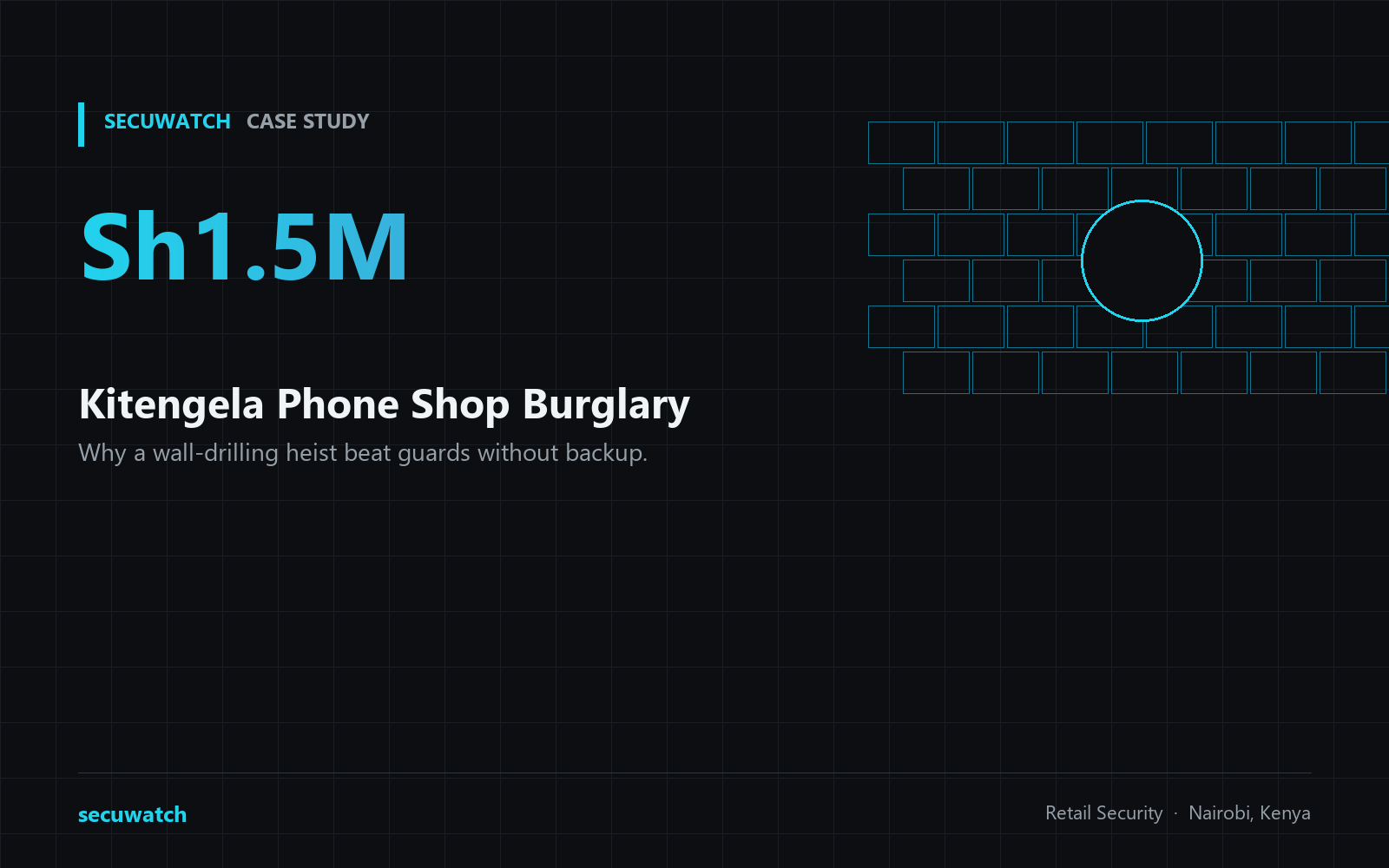
In July 2023, a mobile phone shop trading as Tecno Maafcom in Kitengela lost around 50 brand-new phones and accessories worth roughly Sh1.5 million in a burglary that unfolded almost entirely out of sight. It is a case worth examining closely, not because it was unusually dramatic, but because it illustrates a pattern of retail break-ins that keeps repeating across Kenyan towns, and because it points clearly to where manual security arrangements tend to fall short.
What Happened at the Kitengela Phone Shop
According to reporting on the incident and a police report filed at Kitengela Police Station, a group of more than five suspects struck at midnight and spent roughly five hours carrying out the theft. Rather than attacking the shop's front entrance directly, the burglars first broke into an adjacent shop, then used chisels and other tools to drill a hole through the shared wall into the phone shop itself, a method that has become common enough in the area that several other Kitengela phone and electronics shops had been hit in similar fashion in the months before and after this incident.
The shop had two night guards on duty at the time. Reporting indicates the guards were tied up with ropes and held captive for the duration of the five-hour operation, only being freed the following morning by passers-by. Police took the two guards into custody afterward as "persons of interest" to assist with investigations, a standard step in cases like this rather than an indication of guilt, since establishing whether the guards were complicit or simply overpowered was part of what investigators needed to determine. The shop's CCTV cameras were destroyed during the break-in, and the owner told reporters that the hole in the wall was still fresh when staff arrived the next morning to find the shelves empty. Investigators said they were tracing the stolen phones through their recorded serial numbers, which the shop owner had fortunately kept on file.
Why This Kind of Break-in Is Hard to Stop With Guards Alone
It is worth being precise about what actually went wrong here, because the failure was not simply "not enough security." The shop had guards posted, which is more than many small retail outlets in Kenya can say. The real gap was that the entire security arrangement depended on those two individuals being physically capable of resisting or responding to a group of more than five people, for an extended period, with no mechanical backup of any kind if they were overwhelmed.
This is a structural weakness that shows up repeatedly in Kenyan retail security, and it is not really about guard competence or bravery. A team of two, however alert and well-trained, is simply outmatched by a coordinated group willing to use force and given enough time to work. Once the guards were restrained, there was nothing else standing between the burglars and the shop — no secondary barrier, no alarm that would summon help, no way to lock down the premises independently of the people who had just been tied up. The entire security posture collapsed the moment the human element was neutralised, and the burglars were then free to work undisturbed for hours.
The Broader Pattern in Kenyan Retail Security
The wall-drilling method used in Kitengela reflects a specific, calculated response to how most retail security in Kenya is actually structured. Shop owners understandably focus resources on the front entrance, since that is where customers, deliveries, and casual foot traffic pass through, and it is also the location most guards are trained to watch. Burglars who study a target's routine, as reporting on similar Kitengela incidents suggests some groups do, quickly learn that the front door is the hardest and most heavily monitored point of entry, while a shared wall with a neighbouring, less secure business is often a much easier and quieter route in.
A related but distinct risk pattern also shows up regularly in Kenyan retail and hospitality settings, where armed intruders rush a still-open front entrance during business hours, overpowering unarmed guards through direct confrontation rather than working around them via a side route. Both patterns share the same underlying weakness — a security setup with no mechanical fallback once a human guard is compromised — but they call for slightly different countermeasures depending on whether the threat is a quiet after-hours breach through a weak wall or a fast, forceful entry through an open door during trading hours.
What a More Layered Retail Security Setup Looks Like
For businesses trying to close these specific gaps, a few concrete measures address the vulnerabilities exposed by cases like the Kitengela burglary far more directly than simply adding another guard.
Panic-activated lockdown capability
Panic-activated lockdown capability gives staff a way to respond even after being confronted, provided it can be triggered quickly and discreetly. A silent panic button connected to electromagnetic locks on exterior access points allows a guard or staff member to seal off entry points at the first sign of trouble, ideally before being physically restrained, rather than relying entirely on their ability to resist a group by force. This does not eliminate risk to staff, but it changes the calculation, since a lockdown that has already been triggered continues to function even if the person who triggered it can no longer act.
Reinforced perimeter monitoring beyond the front door
Reinforced perimeter monitoring beyond the front door matters specifically because of how the Kitengela burglary happened. Shared walls with neighbouring units, back entrances, and rooftop access points are exactly the kind of secondary boundary that a front-door-focused security setup tends to overlook. Motion or vibration sensing along these secondary boundaries, rather than cameras pointed solely at the main entrance, would have a far better chance of catching a slow, methodical wall breach in progress.
Entrance control for high-footfall venues
For businesses in high-footfall retail and dining environments specifically facing the risk of a fast, forceful entry rather than a quiet after-hours breach, entry systems such as speed turnstiles or air-lock style vestibules with a dual-push mechanism can slow down or block a sudden rush at the threshold, buying critical seconds during business hours. Paired with AI-assisted camera systems capable of flagging drawn weapons or aggressive movement at the entrance and automatically signalling access control to deny entry, this kind of setup addresses the open-door surge risk more directly than it would have addressed what actually happened in Kitengela, since that incident occurred at night through a side wall rather than a rushed front entrance. It is a genuinely useful measure for a different, related threat pattern that Kenyan shop and restaurant owners also need to plan for.
Choosing the Right Combination for Your Own Shop
No single measure covers every version of this risk, which is really the core lesson from Kitengela. A business needs to think honestly about which threat pattern it is more exposed to — a quiet, patient breach through a weak point away from the main entrance, or a fast, forceful rush through the front door — and often it needs to plan for both. Getting this right usually requires an actual site assessment rather than a generic security package, since the right combination of guarding, panic-lockdown capability, perimeter sensing, and entrance control depends heavily on a shop's specific layout and its neighbouring premises.
Comparing security providers with genuine experience across these different measures, rather than assuming any standard CCTV-and-guard package is enough, is worth the extra effort. At Secuwatch, we help retail business owners in Kenya find and compare vetted providers offering panic-activated lockdown systems, perimeter sensing, and smart access gateways suited to their specific premises, rather than leaving you to rely on whichever installer happens to make the most convincing pitch.
A Grounded Conclusion
The Kitengela phone shop burglary is a clear example of what happens when an entire security strategy rests on two people's physical ability to stop a determined group, with nothing mechanical to fall back on once that resistance fails. Guards remain a valuable part of retail security, but cases like this show why they work best as one layer among several rather than the entire plan. Business owners reviewing their own setup should ask honestly whether their security would still function if their guards were suddenly taken out of the equation, and if the answer is no, that gap is worth closing before it gets tested the hard way.