On the morning of July 18, 2026, journalists checking Kenya's official presidential website found something that should not have been there. The homepage of president.go.ke had been replaced with a message directed at President William Ruto, a Bitcoin wallet address, and a ransom demand equivalent to roughly Sh41 million, with the attackers warning that they would leak confidential information if the payment was not made by that evening. Information, Communications and the Digital Economy Cabinet Secretary William Kabogo confirmed the breach, and the ICT Authority activated its incident response protocols, restricting access to the site while investigators worked to determine how deep the intrusion actually went. The website was fully restored several days later, with officials stating that no sensitive data appeared to have been compromised, though the incident marked the second major attack on government websites in less than a year, following a coordinated breach in November 2025 that had defaced multiple ministry websites simultaneously.
If the country's own presidential website can be breached twice within a year, it is worth asking honestly what that means for an ordinary Kenyan business running a website, a customer database, or a payment system with almost certainly fewer resources dedicated to defending it. The answer, based on the data now available, is that the threat businesses face has grown considerably larger and more automated than most owners realise, and that cybersecurity in 2026 can no longer be treated as separate from the physical security measures a business already invests in.
Just How Big Has Kenya's Cyber Threat Problem Become
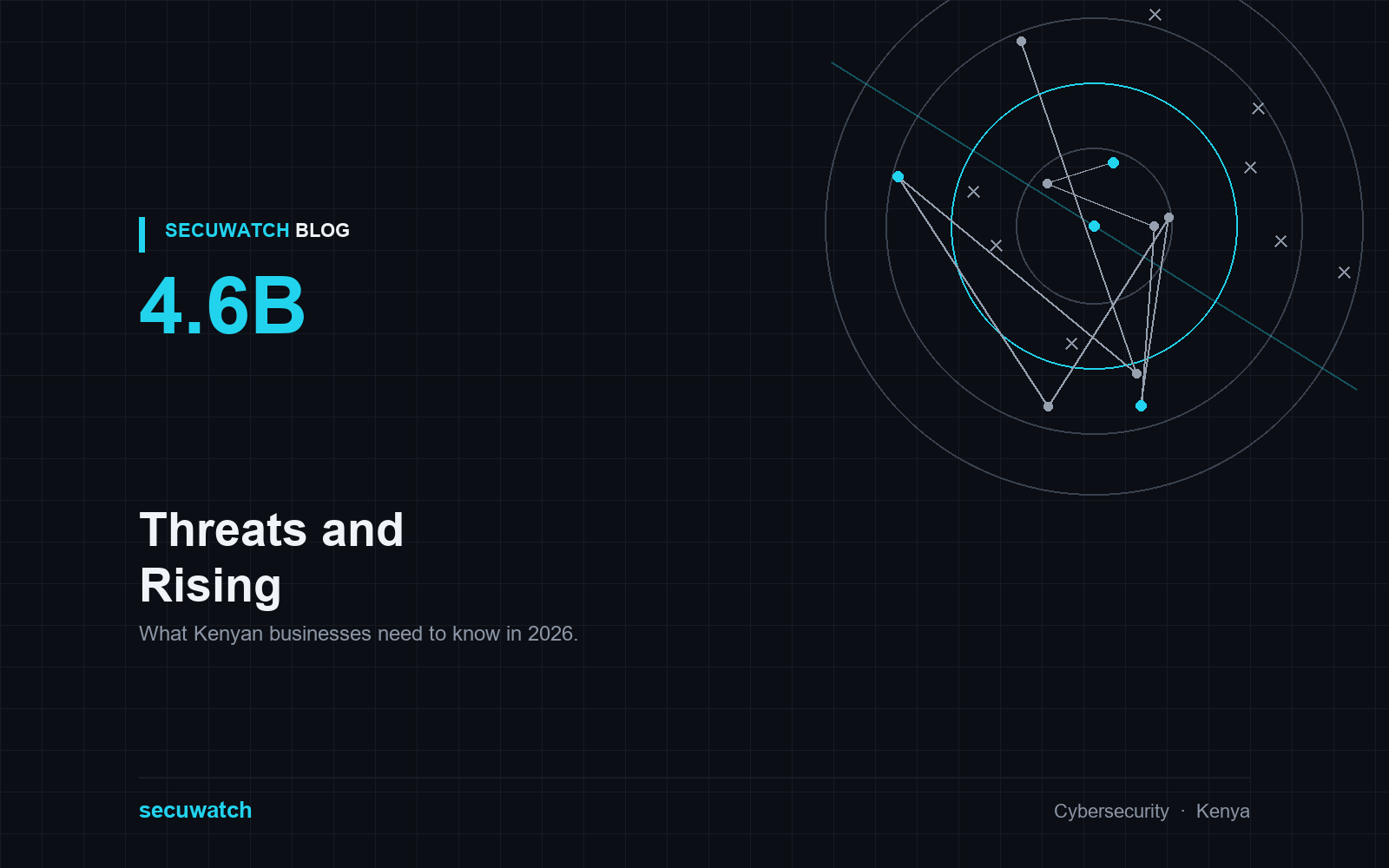
The scale of the numbers involved has genuinely surprised even people who follow this space closely. According to a Communications Authority of Kenya report reviewed by TechCabal, the country recorded 4.6 billion cyber threat events in the three months to December 2025 alone, a 441 percent jump from the 842 million events recorded in the previous quarter, and the sharpest quarterly escalation the national computer incident response centre has recorded in at least three years. System vulnerabilities accounted for the overwhelming majority of that volume, at roughly 4.37 billion events, while distributed denial-of-service attacks, which flood websites and servers with traffic until they collapse, surged more than elevenfold over the same period.
A separate report from the National Computer and Cybercrime Coordination Committee, released in June 2026 and cited in coverage of the State House hack, recorded more than three billion cyberattacks targeting Kenyan government systems, cloud infrastructure, and critical digital services over a three-month window, with Nairobi logging the highest number of cybercrime cases of any county nationally. Authorities attributed much of this surge to the exploitation of AI-driven tools by malicious actors, a trend that has accelerated sharply since 2023, alongside more familiar contributing factors like weak system patching and low user awareness of phishing and social engineering tactics.
These figures describe attacks against government and large institutional infrastructure specifically, and it would be inaccurate to claim they translate directly, event for event, to small and medium Kenyan businesses. What they do tell us reliably is the general direction and scale of the threat environment every organisation operating digitally in Kenya now sits within, and that automated scanning and exploitation tools do not discriminate carefully between a government portal and a small business's customer database sitting on similarly under-patched infrastructure.
Why This Matters for Ordinary Kenyan Businesses, Not Just Government
It is tempting for a small retail shop, a mid-sized logistics company, or a local SACCO to assume that headline-grabbing cyberattacks are a government and large-corporate problem, not something that applies to them specifically. This assumption does not hold up well against how modern automated attacks actually function. A large share of the system vulnerability exploitation driving Kenya's threat numbers involves scanning tools that probe indiscriminately across accessible systems looking for known, unpatched weaknesses, rather than attackers manually selecting high-profile targets one at a time. A small business running an outdated content management system or an unpatched point-of-sale platform is a viable target to this kind of automated scanning regardless of its size or public profile.
Mobile money and fintech infrastructure carries particular weight in this conversation given how central M-Pesa and similar platforms are to everyday Kenyan commerce, processing well over a hundred million transactions daily across infrastructure that sits on the same broad networks these attacks target. Businesses relying on mobile money integrations, online payment gateways, or customer data stored digitally are participating in exactly the ecosystem facing this escalating threat volume, whether or not they think of themselves as a "tech business."
Why Physical and Digital Security Can No Longer Be Treated Separately
This is where the conversation genuinely shifts from a purely IT concern to something that touches access control, CCTV, and physical security planning directly, and it is one of the more underappreciated aspects of Kenya's evolving security landscape.
A meaningful share of serious data breaches globally, and increasingly in Kenya, trace back to a physical security failure somewhere in the chain rather than a purely remote digital exploit. Someone with brief, unauthorised physical access to a server room can install a device that captures network traffic, plug in hardware that establishes a persistent remote foothold, or simply access an unlocked administrative workstation left logged in. A retail business with weak stockroom access control faces the same fundamental accountability problem whether the thing walking out the door is a box of inventory or a laptop containing customer payment records.
This is precisely why properly integrated access control and CCTV monitoring matter as much to a business's cybersecurity posture as its firewall configuration does. Restricting and logging who can physically reach a server, a networking cabinet, or an administrative terminal, and having genuine, monitored camera coverage of those specific points rather than generic office coverage, closes a gap that no amount of purely digital investment addresses. Increasingly, AI-assisted analytics tie these layers together further, with smart CCTV systems capable of flagging unusual movement or loitering near sensitive infrastructure automatically, feeding into the same kind of real-time alerting logic that a modern cybersecurity operations centre relies on for digital threats. Security, in practice, is converging into a single discipline whether or not a business's internal org chart reflects that yet.
Practical Steps Kenyan Businesses Should Take in 2026
Given the scale of what the Communications Authority and National Computer and Cybercrime Coordination Committee data describes, a few practical priorities stand out for businesses without dedicated cybersecurity teams:
- Keep software, content management systems, and point-of-sale platforms patched and updated, addressing the single largest category of exploited vulnerability by volume, according to the CA's own reporting.
- Restrict and log physical access to any location housing servers, networking equipment, or administrative devices, closing the physical-to-digital gap described above.
- Enable multi-factor authentication on financial platforms, email, and administrative accounts, meaningfully reducing the impact of credential compromise, one of the more common outcomes of successful phishing and social engineering attempts.
- Build basic staff awareness of phishing and social engineering tactics, addressing the human element that automated technical defences alone cannot fully cover.
Finding the Right Support for a Layered Security Approach
Given how intertwined physical and digital security have become, Kenyan businesses evaluating their overall security posture increasingly need to think about access control, CCTV monitoring, and cybersecurity readiness as connected parts of the same risk picture rather than separate line items handled by entirely different vendors. Comparing providers who understand this convergence, rather than committing to a purely physical security installer or a purely IT-focused firm working in isolation from each other, is a worthwhile exercise for any business serious about closing these gaps properly. Platforms such as Secuwatch Tech can help Kenyan business owners find and compare vetted security providers who understand how physical access control, CCTV monitoring, and broader security planning fit together, rather than treating each as an isolated purchase disconnected from the others.
Conclusion
The numbers coming out of Kenya's Communications Authority and national cybersecurity coordination bodies in 2026 describe a threat environment that has grown considerably faster than most businesses' security investment has kept pace with, and the State House website breach is a stark, very public reminder that even the country's most visible digital infrastructure remains vulnerable. For ordinary Kenyan businesses, the practical lesson is not to panic, but to recognise that digital and physical security have become genuinely inseparable, and that closing the gaps in one without addressing the other leaves a real, exploitable weakness regardless of how much has been invested elsewhere. Taking stock of both sides of that equation, deliberately and honestly, is a considerably better use of a business's limited security budget than treating either half of the problem in isolation.