There is a particular kind of blind spot that shows up in even well-resourced IT departments across Kenya. A CISO can spend months hardening firewalls, rolling out multi-factor authentication, and running phishing simulations, and still overlook the fact that the server room door has been propped open with a fire extinguisher since the air conditioning technician left three hours ago. Cybersecurity and physical security have historically been treated as separate disciplines, run by different teams, budgeted separately, and audited on entirely different schedules. That separation made a certain kind of sense when data lived exclusively behind digital perimeters. It makes considerably less sense now, when the fastest way into a network is sometimes simply walking through an unlocked door.
For IT directors and security leaders in Kenya heading into 2026, the case for a converged security risk review, one that treats physical security assessment and cybersecurity audit as two halves of the same problem rather than parallel tracks, has become considerably harder to ignore.
Why Kenya's Cyber Threat Landscape Makes This Urgent
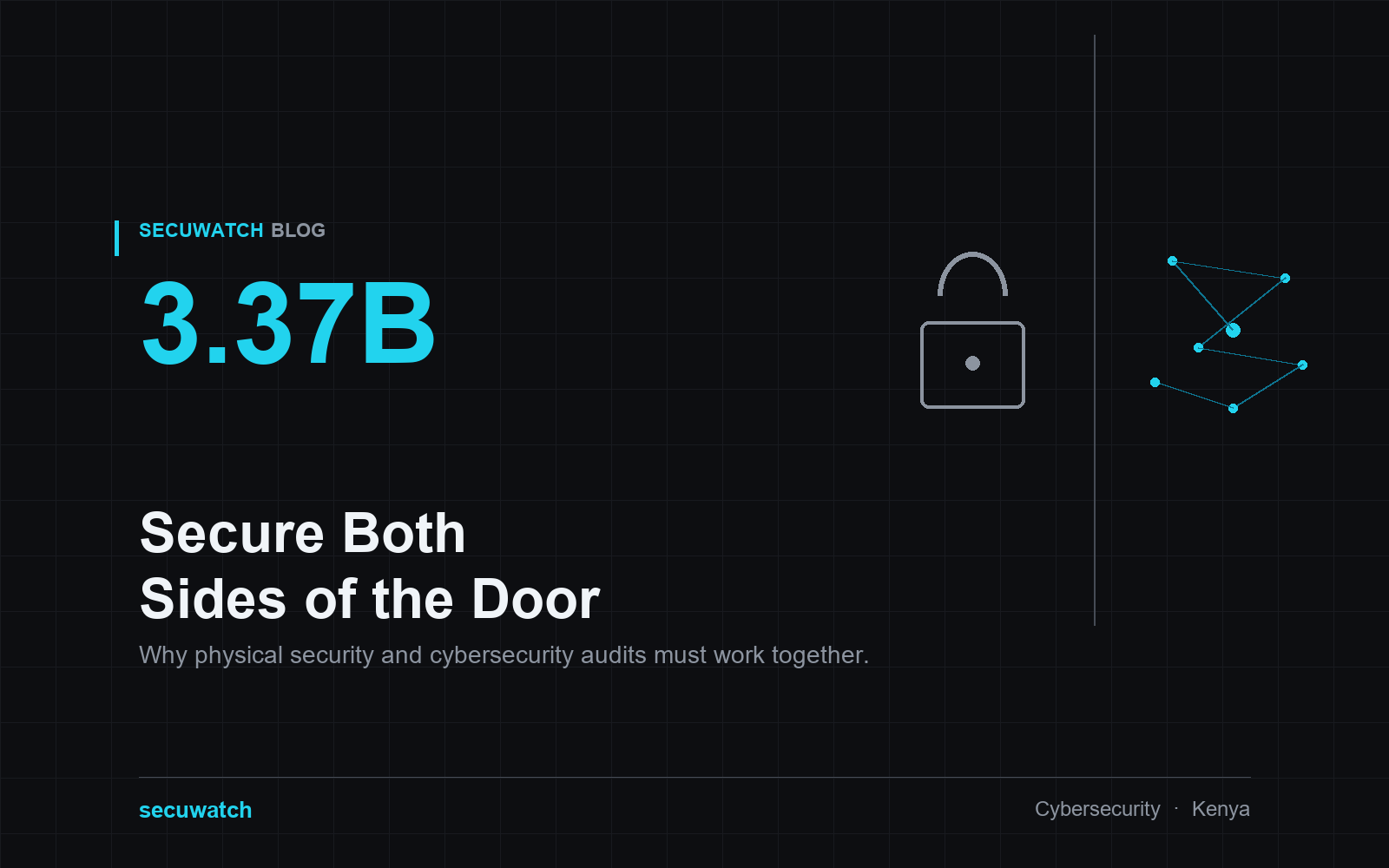
The scale of cyber threats targeting Kenyan institutions has grown sharply in recent reporting periods. According to the Communications Authority of Kenya's own quarterly figures, the country recorded more than 3.37 billion cyber threat events between January and March 2026 alone, with system vulnerabilities and AI-assisted attacks identified as major contributing factors. The Authority has repeatedly pointed to inadequate system patching, weak authentication, and limited security awareness as persistent drivers of this volume, and while most of these attacks are purely digital in origin, a meaningful share of serious breaches still trace back to a physical access failure somewhere in the chain.
This is not a new phenomenon globally, but it remains under-discussed in Kenya specifically, where security investment conversations still tend to default to either "we need better firewalls" or "we need better guards," rarely both in the same planning cycle. A facility security threat analysis that ignores digital consequences, or a cybersecurity audit that ignores who can physically walk up to a server rack, both leave a genuine, exploitable gap.
How Physical Breaches Become Cyber Incidents
Understanding the specific mechanics of physical-to-cyber attack vectors makes the case for convergence far more concrete than a general appeal to "holistic security."
Unauthorised Server Room and Rack Access
A server room with weak access control, a shared key, an unlogged entry system, a door that does not fully latch, creates an opportunity for anyone with brief, unsupervised access to plug in a device, extract data directly from a physical drive, or install hardware capable of intercepting network traffic. This risk is not theoretical. Kenyan banks and financial institutions have dealt with real cases of physical tampering with financial hardware, including a widely reported incident in Meru where fraudsters physically inserted a skimming device into a bank ATM's card slot, compromising every customer who used that machine over a several-day window before the device was discovered. While an ATM slot is not a server rack, the underlying principle is identical: physical access to hardware, even briefly and even without triggering any digital alarm, can compromise an entire system's integrity.
Rogue USB Drops and Drop Boxes
A classic and still remarkably effective physical-to-cyber attack involves leaving a USB drive in a parking lot, reception area, or shared office space, relying on an employee's curiosity to plug it into a work computer, at which point malware executes automatically. A related, more sophisticated version involves a small network implant device, sometimes disguised as an ordinary power adapter or network switch, physically connected to an office network by someone who gained brief unsupervised access, giving attackers a persistent remote foothold inside a network that otherwise looks perfectly secure from the outside. Neither of these techniques requires any cybersecurity vulnerability at all. They require only a gap in physical access control.
Tailgating Into Restricted IT Areas
The same tailgating risk that affects general office access control becomes considerably more serious when the restricted area in question houses networking equipment, backup servers, or administrative workstations with elevated system privileges. An organisation can have excellent network segmentation and access logging in place digitally, and still be fully exposed if the physical door protecting that infrastructure can be bypassed by someone simply following an authorised employee through it.
What a Converged Security Risk Review Actually Covers
Bringing physical and cybersecurity assessment together does not mean merging two entirely different skill sets into one generalist role. It means ensuring both assessments are conducted with awareness of the other, and that findings from one inform priorities in the other.
Mapping Physical Access to Digital Assets
A converged review starts by identifying exactly which physical locations house which digital assets, server rooms, network cabinets, backup storage, administrative workstations, and then assessing physical access control at each of those specific points with the same rigour typically reserved for perimeter security. This includes reviewing who holds keys or credentials to these spaces, whether access is logged, and whether that access list has ever actually been audited against current staffing rather than simply assumed to be accurate.
Testing for Social Engineering and Tailgating
A thorough assessment should include realistic testing of whether an unauthorised individual could plausibly gain access to restricted digital infrastructure through social engineering or tailgating, since policy documents stating that visitors must be escorted mean little if that policy is not actually enforced in daily practice.
Reviewing CCTV Coverage of Critical Infrastructure Points
Server rooms, network cabinets, and other critical infrastructure locations deserve dedicated CCTV coverage and, ideally, active monitoring, not as an afterthought bolted onto a general office security system, but as a deliberate control specifically tied to protecting digital assets. This is an area where physical security investment and cybersecurity risk reduction directly overlap, since footage of who accessed a server room, and when, becomes critical evidence in investigating any suspected physical tampering incident.
Correlating Physical and Digital Logs
Organisations with more mature security programmes increasingly correlate physical access logs with digital system logs, flagging situations where a system was accessed digitally at a time when no corresponding physical badge entry was recorded for that location, which can indicate either a credential compromise or an undetected physical breach worth investigating.
Building the Business Case for Convergence
CISOs and IT directors proposing this kind of converged approach to leadership often find the strongest argument is a straightforward one: physical security failures create digital consequences that are considerably more expensive to remediate than the physical fix would have cost in the first place. A compromised server due to unauthorised physical access can mean regulatory exposure under Kenya's Data Protection Act, reputational damage, and incident response costs that dwarf the price of a properly configured door lock and monitored access point.
It is worth being clear-eyed that convergence is a process, not a single project with a defined end date. Organisations should expect to run physical and cyber assessments on a recurring schedule, treating each as an input into the other rather than a one-time exercise, and should budget for both disciplines with the understanding that underinvesting in either one undermines the other regardless of how well resourced it is individually.
Practical Steps for IT Directors Starting This Process
Begin by identifying every physical location that houses digital infrastructure of genuine consequence, and confirm that access control and monitoring at each location matches the actual sensitivity of what it protects, rather than the general office security standard applied uniformly across a building. Review whether CCTV coverage of these specific locations is adequate and, critically, whether footage is actually monitored or reviewed rather than simply recorded and forgotten. And build a habit of asking, whenever a cybersecurity incident is investigated, whether a physical access failure played any role, even a minor one, since this is exactly the kind of correlation that gets missed when physical and digital security teams operate in separate silos.
For the physical security side of this equation specifically, working with a provider experienced in securing sensitive infrastructure locations, rather than a general office security installer, makes a meaningful difference. Secuwatch Tech offers CCTV monitoring set-up specifically suited to critical infrastructure points such as server rooms and network cabinets, ensuring these areas receive the dedicated, actively monitored coverage they warrant rather than being treated as just another corner of a general office camera layout. Organisations building out a converged security review can also use Secuwatch Tech to compare vetted providers in Kenya with genuine experience securing IT-critical physical spaces, rather than assuming any general security contractor understands the specific risks involved.
A Grounded Conclusion
Physical security and cybersecurity have spent years developing as separate disciplines, with separate budgets, separate audits, and separate teams, and that separation increasingly looks like exactly the kind of gap that determined attackers are willing to exploit. A server room protected by excellent digital access controls but a weak physical lock is not actually secure. Neither is a beautifully guarded building running outdated, unpatched systems inside it. For Kenyan organisations serious about reducing genuine risk in 2026, the two assessments need to inform each other, because increasingly, the attackers already understand that the line between physical and digital security was never as solid as most organisational charts suggest.